
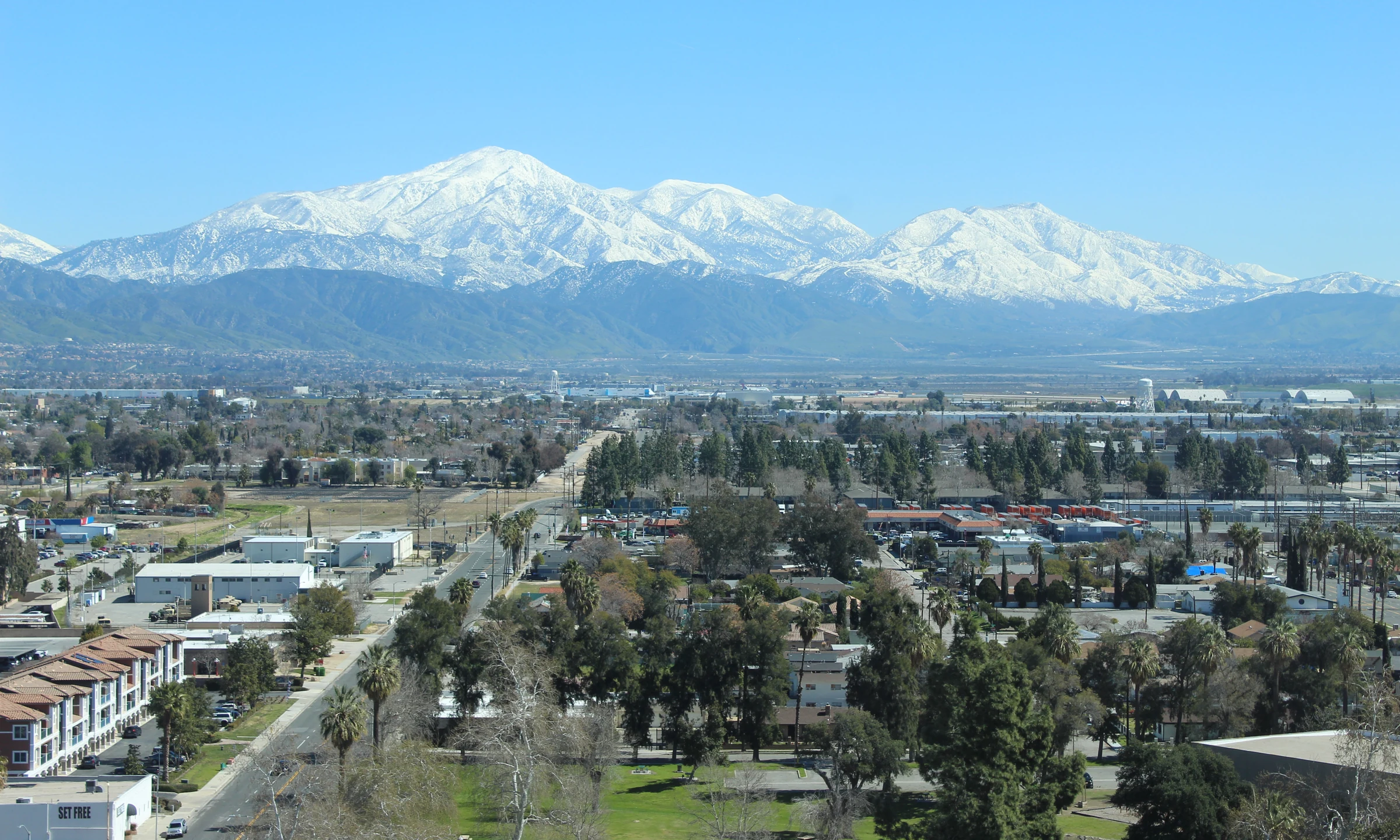
Commercial Roofers in Grand Terrace
For commercial properties in Grand Terrace, the defensible choice between repair, restoration, and replacement starts with roof-system condition, moisture findings, drainage performance, and remaining service life. Grand Terrace is a small city, and most of its commercial roofs are small too. Barton Road carries the retail base, a scatter of light industrial sits along the I-215 frontage, and Blue Mountain rises directly behind the whole footprint. We treat these smaller buildings with the same inspection rigor we'd bring to a much larger property, because a leak doesn't care how many square feet the roof covers.
Barton Road's Small-Footprint Retail Roofs
The retail strip along Barton Road is mostly single-story, low-slope buildings under 15,000 square feet, a size that owners sometimes assume doesn't justify a real maintenance program. That assumption costs money over time. A small roof still has parapets, still has drains, still has HVAC penetrations, and all of them fail the same way a big roof's do, just on a shorter timeline to notice because the whole building floods faster when something goes wrong.
We size our inspection and repair approach to the building rather than defaulting to a scaled-down version of a warehouse service. On a Barton Road strip center, that usually means a full-roof walk takes under an hour, but we don't skip sections just because the property is compact.
The I-215 Industrial Pocket
Grand Terrace's stretch along I-215 holds a modest cluster of light industrial and flex-space buildings, smaller than the mega-distribution product in Moreno Valley or Perris but built with the same low-slope systems. These buildings tend to be older, with metal or built-up roofing that's had less capital investment over the years than the newer big-box product elsewhere in the corridor.
Tenant turnover in this pocket often brings new rooftop HVAC or exhaust needs, and we see plenty of penetrations added by whoever installed the last tenant's equipment without much thought to how it integrates with the existing roof system. We re-flash those additions properly rather than leaving a mismatched patch that becomes tomorrow's leak call.
Small Buildings, Same Problems as the Big Ones
Owners of smaller commercial buildings sometimes get less attention from roofing contractors who'd rather chase bigger jobs. That's backwards from how the actual risk works. A small building's roof still needs seam integrity, still needs proper drainage, and still needs flashing that holds up to wind and heat. We give Grand Terrace's buildings the same documentation and the same walk-the-whole-roof approach we use on a distribution center ten times the size.
The financial stakes are proportionally just as real for a small owner. A leak that damages inventory or interrupts a single-tenant retail operation can be as disruptive to that business as a much larger loss would be to a bigger company.
We also find that small-building owners are more likely to be handling the roof decision themselves rather than through a property management layer, which means the conversation is usually more direct: an owner-operator wants to know exactly what's wrong, what it costs, and how long a repair buys them, without the extra step of translating that into a report for an out-of-state asset manager.
What We Handle in Grand Terrace
Common work on Grand Terrace's commercial roofs:
- Full-roof inspection and documentation regardless of building size
- Re-flashing tenant-installed HVAC and exhaust penetrations
- Drain and scupper clearing on small parapet roofs
- Wind damage repair at parapet corners after Santa Ana events
- Recover and reroof estimates for aging built-up and metal systems
- Scheduled maintenance programs sized to a small building's budget
Blue Mountain Runoff and Drainage
Grand Terrace sits at the base of Blue Mountain, and buildings closer to the hillside deal with runoff patterns that push more water toward their roof drains during a hard winter storm than a flat-site building elsewhere in the Inland Empire would see. We check drain capacity and scupper placement against that runoff pattern, because a drainage system sized for average conditions can back up fast when the hillside sheds water toward the building faster than the roof was designed to handle it.
Ponding water on an older built-up roof is one of the fastest ways to shorten its remaining service life, so getting drainage right matters more here than on a flat-site building without a hillside contributing runoff.
Questions Grand Terrace Owners Ask
Is it worth setting up a maintenance program for a small building?
Yes. Small roofs fail the same way large ones do, and catching a loose flashing detail or a clogged drain early costs far less than the leak repair that follows if it's ignored.
Our tenant added rooftop equipment without telling us. What now?
We inspect the penetration and re-flash it properly if it wasn't done right the first time. Unauthorized rooftop additions are one of the most common sources of leaks we find on smaller multi-tenant buildings.
Does being near Blue Mountain actually affect our drainage?
It can. Buildings closer to the hillside see more runoff pushed toward their roof during storms. We check drain and scupper capacity against that pattern rather than assuming standard sizing is enough.
How do you price work on a small building fairly?
We scope based on actual roof condition and square footage, not a blanket minimum built for larger commercial work. A small roof gets a small-roof estimate.
Can you match a repair to an existing patch job from a previous roofer?
Usually, though we'll tell you honestly if the existing patch was done poorly and needs to come out rather than be matched. Building on a bad repair just extends the problem.