Built-Up Roofing on San Bernardino's Older Commercial Buildings
Built-up roofing, alternating layers of asphalt and felt, usually finished with a gravel ballast, is the oldest roof system we still service regularly. Most of it sits on buildings that have been standing since well before single-ply membrane existed, and it comes with its own set of problems.
Where BUR Still Covers a Roof Deck Here
Downtown San Bernardino's older civic and commercial buildings carry a fair amount of BUR, along with older institutional stock, sections of Patton State Hospital's campus and the older wings at facilities like Arrowhead Regional Medical Center fall into this category. These are buildings built to a different standard, decades before tilt-up warehouse construction became the regional norm.
Age alone doesn't mean a BUR roof is failing. Plenty of these systems, if maintained and not overloaded with repeated patch work, are still doing their job.
Three, Four, or Five Ply: What's Actually Up There
BUR systems are built in layers, alternating asphalt and felt or fiberglass ply sheets, with the total ply count driven by the original spec and local wind and fire code at the time of install. More plies generally means more redundancy, but also more weight and more history to account for during a repair.
Before we touch a BUR roof we confirm ply count and construction, usually by cutting a small test section, rather than guessing based on the building's age or the gravel on top.
Gravel Ballast and Why It Hides Problems
The gravel layer on a BUR roof protects the asphalt underneath from UV exposure and adds weight against wind uplift, but it also hides the membrane surface from a simple visual inspection. A crack, blister, or worn spot under two inches of gravel doesn't show up until we move the rock aside.
That's why a proper BUR inspection means physically pulling gravel back in suspect areas, rather than walking the roof and looking at the surface from a distance.
Finding a Leak on a BUR Roof
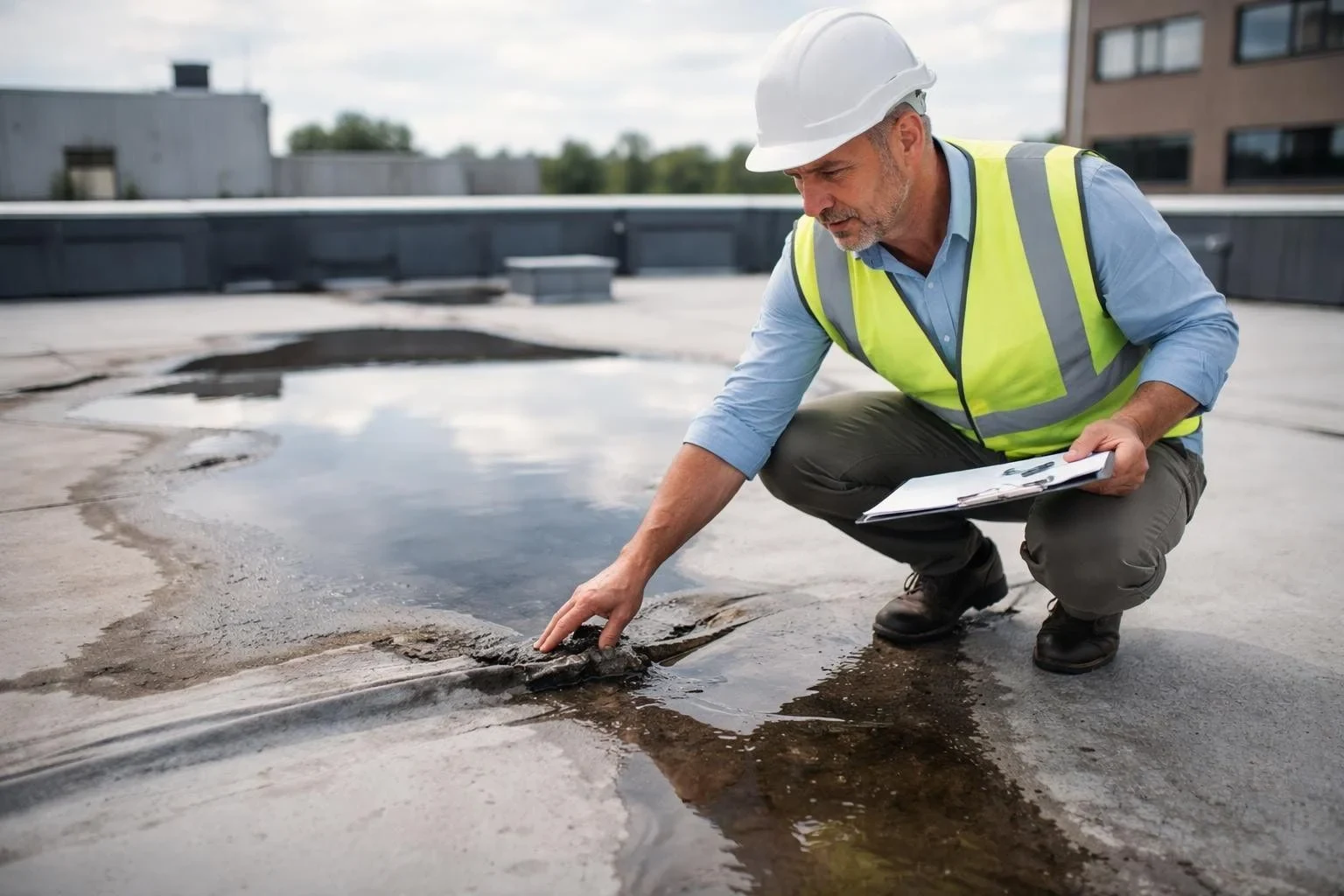
Water on a built-up roof travels laterally under the membrane before it finds its way through, which means the leak inside the building is often nowhere near where the water is actually entering on the roof. We trace leaks by checking drainage patterns, ply seams, and flashing details systematically rather than assuming the interior stain marks the exact spot above it.
Parapet flashing and drain bowl transitions are the most common entry points we find, more often than failures out in the open field.
- Alligatored or dried-out surface asphalt
- Wet insulation discovered beneath the membrane
- Gravel washed away from drain and low-point areas
- Split membrane at expansion joints
- Standing water at structural low points
- Deteriorated base flashing at parapet walls
Recover Options When Full Tear-Off Isn't in the Budget
If a moisture scan comes back dry and the deck is structurally sound, we can often install a new cap sheet or a single-ply recover membrane directly over an existing BUR system rather than stripping it down to the deck. That keeps cost and downtime manageable for institutional owners working within tight capital budgets.
When the scan shows wet insulation spread across the field, recover isn't a responsible option, at that point full tear-off is the only fix that actually solves the problem instead of sealing it in.
Public and institutional buildings often work on multi-year capital planning cycles, so we lay out a phased approach when that's realistic, addressing the worst sections first while budgeting for the rest over subsequent years, rather than insisting on an all-or-nothing replacement the owner can't fund in one pass.
Questions Owners Ask About Built-Up Roofs
How do you inspect a roof when gravel is covering the whole surface?
We physically clear gravel from sample areas and any suspect spots, drains, flashings, low points, rather than relying on a surface walk alone.
Is it worth repairing an old BUR roof or should we replace it?
Depends on ply condition, moisture scan results, and how many prior patches are already stacked on the roof. We give a straight answer after the survey rather than defaulting to replacement.
Can you install a single-ply membrane over an existing BUR roof?
Often yes, as long as the deck is dry and structurally sound and code layer limits allow it. We confirm both before recommending it.
Why does a BUR roof leak somewhere different from where the ceiling stain shows up?
Water moves sideways under the membrane and insulation before it finds a path down through the deck, so the entry point on the roof can be several feet from the interior damage.
How often should an older BUR roof be checked?
Twice a year at minimum, plus after any significant wind or rain event, given how much these systems hide problems under gravel and how much history is usually already built into them.