Documentation That Holds Up When a Roof Claim Gets Reviewed
Wind and storm damage claims on commercial roofs in this market usually come from the same handful of causes: a Santa Ana event that peels back a membrane edge, a winter storm that overwhelms drains nobody cleared, or hail moving through the high desert corridors near Hesperia and Victorville. We work with building owners, restoration general contractors, and public adjusters on the roofing side of those claims, and our job is to put facts on paper before anyone starts arguing about them.
Who We Work Alongside on a Claim
A restoration claim usually has several parties who need the same information for different reasons. The building owner wants the roof fixed and the business interrupted as little as possible. The public adjuster or the carrier's field adjuster needs a scope and cost that matches the actual damage, not an inflated or deflated version of it. A restoration general contractor coordinating interior repairs needs the roof scope locked down before they can finish their own estimate. We write one set of findings that all three can use.
We do not promise claim outcomes, and we tell every owner that up front. What we can promise is an honest, thorough condition assessment: what's damaged, what caused it, what it costs to repair correctly, and photographic proof of all three. What the carrier decides to pay is between the owner and the carrier.
Getting to the Roof Before the Damage Gets Worse
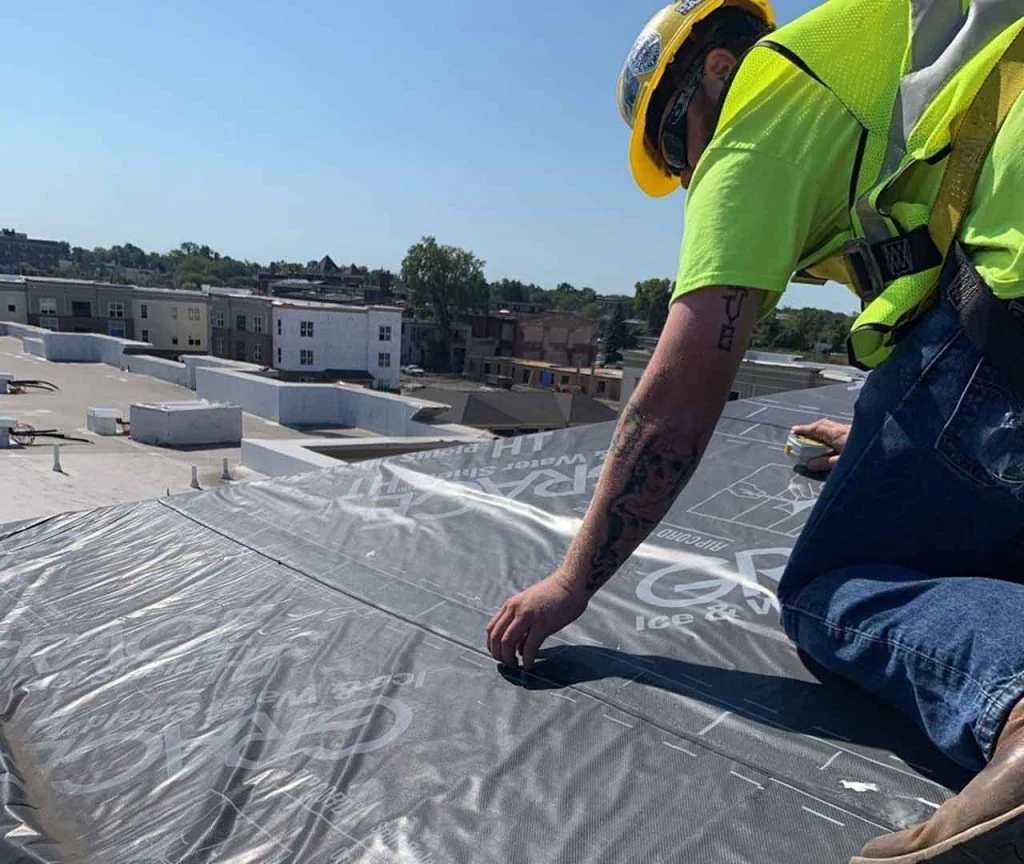
The first calls after a wind or hail event are about stopping ongoing water intrusion, not settling a claim. We prioritize emergency dry-in and temporary repair on any roof letting water into the building, because a delayed tarp turns a roof claim into a roof-plus-interior claim, and that second part is a lot harder to trace back cleanly to the storm once time passes. Getting water stopped fast also protects the claim itself, carriers expect an owner to mitigate further damage, and a documented same-day response supports that.
Once the building is protected, we move to the full assessment: what the storm actually did versus what was already wearing out before the event. That distinction is where a lot of claims get contested, and it's the single most important thing our report needs to get right.
Separating Storm Damage From Pre-Existing Wear
Every roof has some age-related wear before a storm ever hits it, UV-brittled seams, worn flashing sealant, membrane that's simply due for replacement. Carriers push back hard when a claim tries to fold pre-existing wear into storm damage, and rightly so. We document both categories separately and explain the difference in plain terms: this seam failed because wind uplift tore it during the event, this one was already cracked from years of UV exposure and the storm just happened to find it.
That distinction protects everyone. It gives the owner a credible claim instead of one that gets challenged and delayed. It gives the adjuster a report they can actually rely on. And it gives us a record we stand behind if the claim gets reviewed again months later.
What Our Claim Documentation Package Includes
- Date-stamped photos of every damaged area, cross-referenced to a roof plan diagram
- A written cause-and-effect assessment separating storm damage from pre-existing wear
- Core samples or moisture scans where subsurface damage is suspected but not visible from the top
- A detailed repair or replacement scope broken out by system component, not a lump sum
- Emergency mitigation records showing when temporary protection was installed relative to the storm date
- A point of contact available for adjuster site visits and follow-up questions on the report
Working Alongside Restoration Contractors
On larger losses, a restoration general contractor often handles the whole building, interior, contents, and structure, while we handle the roof scope specifically. We coordinate directly with that GC so the roof repair sequence lines up with their interior drying and reconstruction timeline, and so nobody duplicates scope or leaves a gap between the roof work and the ceiling work below it. Our emergency tarp and dry-in and storm damage repair services are set up for exactly this handoff.
We also see claims where the roof itself was never inspected after a storm because the interior damage was the obvious problem. If your building took an interior loss recently and nobody has been on the roof since, that's worth checking, a storm that damaged flashing or membrane without an immediate visible leak can keep causing slow damage for months before it surfaces again.
Claim Questions Owners and Adjusters Ask
Can you guarantee my claim gets approved?
No, and we would not trust a contractor who told you otherwise. What we provide is accurate, well-documented findings on the actual condition and cause of damage. The approval decision belongs to the carrier.
How do you tell storm damage apart from normal wear and tear?
By physical evidence, the failure pattern from wind uplift looks different than UV-brittled sealant failure, and hail impact leaves a distinct mark pattern on most membrane types. We document both categories separately in every report.
Can you meet with our adjuster on-site?
Yes, and we do this regularly. Having the person who wrote the assessment walk the roof with the adjuster resolves most questions faster than an email exchange.
How fast can you get emergency protection on a roof after a storm?
We treat active water intrusion as an emergency and prioritize dry-in same day or next day depending on the extent of damage and how many properties are calling in after the same event.
We're working with a restoration general contractor already. Can you just handle the roof portion?
Yes, that's a common arrangement. We scope and repair the roof, coordinate our schedule with the GC's interior timeline, and hand over documentation that plugs into their overall project file.